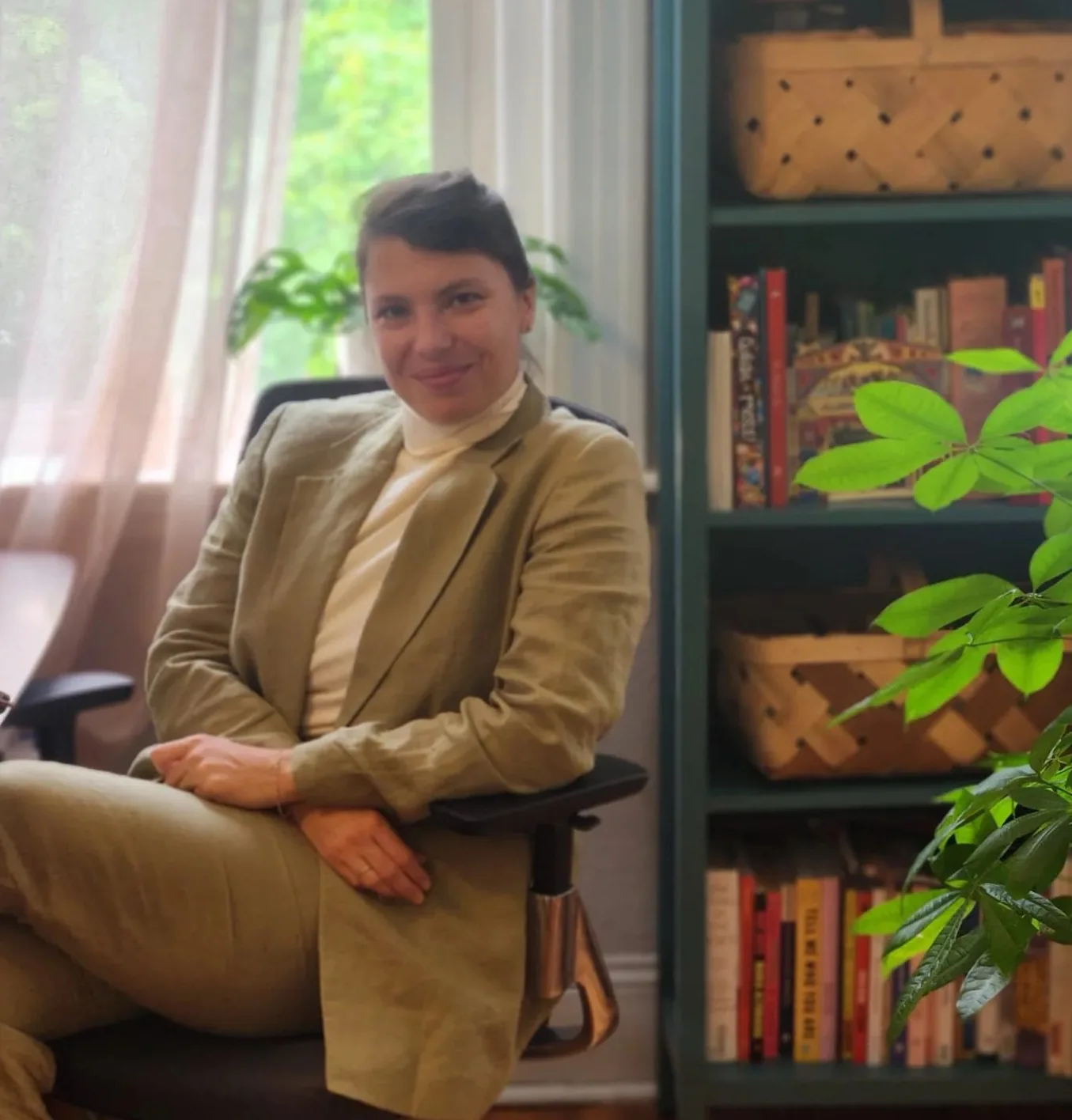
Finding a therapist takes real labor. To help you make an informed decision, I've put together some information about myself and how I think about this work, covering me as a person, my licensure, and my clinical approach. If you're just looking for the basics, here's the short version: I am a licensed couple and family therapist in NY and MD, hold a master's in couple and family therapy, also hold a master's in child clinical psychology, and am a certified emotionally focused couple therapist. The sections below go deeper.
One of the most important components of a helpful therapeutic relationship is the human connection, that sense of "click" with your therapist. What that looks like varies from person to person, so I encourage you to shop around. Like many therapists, I offer a free consultation so you can get a sense of me before committing.
I aspire to be warm and to genuinely care for my clients, and most of them feel that care, because it's real. That foundation is what allows me to be honest, to challenge directly, to make mistakes and repair them, and to keep checking that the work is actually useful to you. I share my knowledge and resources openly, so you can think critically and decide for yourself what applies.
A therapist's licensure and modality can give you a window into their approach. I am licensed in New York and Maryland as a Licensed Marriage and Family Therapist, a licensure that centers on understanding a person within the systems they belong to.
This systemic approach shaped how I think about change. In my previous career, I worked as a clinical child psychologist. I enjoyed individual work with kids, but noticed I was most impactful when I could also work meaningfully with their parents on co-parenting. Later, through my couple and family training, I came to understand the mechanisms through which couples' relationship struggles directly shape children's symptoms. Often, the most powerful place to create change is within the parts of the system that hold the most power.
Licensure: New York 002429 | Maryland LCM1065
I am a certified emotionally focused therapist (EFT), a rigorous process that involved coursework, supervision with a certified EFT therapist, and submitting session videos for review with my clients' consent. My mentor through this process, Flori Willard, was a meaningful part of that training.
EFT helps couples slow down, notice their patterns, understand what those patterns mean emotionally for each partner, and share that with each other, ultimately fighting the pattern together rather than each other, and feeling closer in the process.
That said, I've found EFT works best in combination with other approaches. Mindfulness and somatic practices from Buddhist psychology help couples actually slow down in session, often the only way to interrupt a cycle of disconnection is through the body. Buddhist thought also offers a serious framework for questions of accountability: who needs to change, who is causing harm, how do we hold boundaries without losing compassion. I develop this area of my practice through ongoing supervision with Brian Livelsberger. Where Buddhist approaches fall short for me is in processing anger, and for that, psychoanalytic and dynamic thought has been the more useful resource.
Cultural literacy is an essential part of my work as a therapist. As an immigrant, I understand the pain of living with a marginalized identity and how deeply it shapes our sense of self and our relationships. Many people carry quiet "shoulds" imposed by society that can feel discriminatory or suppressive. Naming these pressures can be deeply healing, especially when you are able to stand with the people close to you.
At the same time, this work is not simple. It often involves sitting with ambiguity, holding multiple perspectives, and making sense of experiences that do not always fit neatly into categories. In our work together, your cultural heritage will be part of the process, whether it relates to queerness, country of origin, race, ethnicity, kink, and nonmonogamous relationships. These are not side notes, they are central to how we understand your story, your pain, and your path toward healing.